
Every host has seen it. The room fills up, drinks are poured, and people drift towards the two colleagues or friends they arrived with. An hour later, most of the guests have spoken to three people, and the person who came alone has spoken to nobody.
The problem is rarely that people do not want to meet. It is that walking up to a stranger needs a reason, an opener and an exit, and an open mingle provides none of them.
Speed networking fixes that by giving everyone all three. Short rounds, a clear partner each time and a question to start with turn "go and network" into something anyone can do. It works for community meetups, friendship events, conference breaks and company onboarding days, and it is the reason we built Speed Networking in Neegma, which is now open on every paid plan.
What speed networking is, and why it works
Speed networking borrows the shape of speed dating. People meet one other person for a few minutes, a signal ends the round, and everyone moves on to someone new. Over 30 to 45 minutes, each guest has a real conversation with eight or ten people instead of hovering at the edge of one group.
It works because it removes the three hardest parts of meeting strangers:
- The approach. You are told who to talk to, so nobody has to interrupt a group or stand alone.
- The opener. A question card gives both people something to say in the first ten seconds.
- The exit. The round ends for everyone at once, so nobody has to invent a reason to leave.
That last point matters more than it sounds. People commit to a conversation more fully when they know it will end politely in three minutes.
Speed friending: when the goal is friendship, not business
Not every room is about careers. Libraries, breweries, community centres and clubs now run speed friending nights for adults who want to widen their circle, and the need is real. In Pew Research Center's 2025 study of men, women and social connections, 16% of US adults said they felt lonely or isolated all or most of the time, and another 38% said they sometimes did.
If you are wondering how to make friends as an adult, the honest answer is repetition: meeting the same people more than once, in a setting with something to do. A speed friending round is a good first step because it turns a room of strangers into a room of people you have already spoken to. The next coffee, game night or meetup is easier when you recognise five faces.
For community organisers, a few things change compared with a business event:
- Use warmer questions. "What did you want to be when you were ten?" travels further than "What do you do?"
- Go a little longer. Four or five minutes gives friendship-style chats room to get past the basics.
- Plan what happens next. End with a game, a shared table or a reason to come back, so new connections have somewhere to go.
Our community event recap from Manchester shows how much a room changes once people have a reason to talk.
Corporate events: building connections across teams
Inside a company, the people who would benefit most from meeting each other often never do. Engineering sits with engineering, sales with sales, and new starters only meet their own team. Speed networking is one of the simplest corporate networking event ideas because it mixes people across departments, levels and offices in under an hour.
It fits naturally into:
- Onboarding days, so a new cohort meets each other and a few people outside their team in week one.
- All-hands and offsites, as a 30-minute block between the talks and the dinner. Pair it with the ideas in our guide to team bonding games for company offsites.
- Mentoring programmes, where a "speed mentoring" round lets juniors meet several senior colleagues briefly before choosing who to follow up with.
- Merged or hybrid teams, where people know each other's names from chat but have never had a proper conversation.
Keep work questions light. "What is something you learned this year that surprised you?" opens more doors than "What are you working on?", and it gives quieter people a fair start.
Conference networking: making the breaks count
At conferences, the hallway is where the value is, but it rewards the confident. A structured round in a break or before the evening reception gives every attendee the same number of introductions, and it pairs well with a conference icebreaker game earlier in the day. Run it in the main room straight after a session, while people are already seated and paying attention, rather than in a crowded foyer.
How to run a speed networking event
Timings that work
| Group | Chat length | Number of chats | Total time |
|---|---|---|---|
| Conference break | 3 minutes | 5 to 6 | 20 to 25 mins |
| Company onboarding or team | 3 to 4 minutes | 6 to 8 | 30 to 40 mins |
| Community or speed friending | 4 to 5 minutes | 6 to 8 | 35 to 50 mins |
Leave a few seconds between chats for people to say goodbye and find the next person. Without it, rounds blur and the last minute of every chat is spent looking around the room.
Matching without the clipboard
The old way is rotating tables or two lines that shift along one seat. It works for small groups, but it falls apart when the numbers are odd, someone arrives late, or two colleagues keep landing together. The goal is simple to state and hard to do by hand: everyone meets someone new each round, and nobody meets the same person twice while someone new is free.
Odd numbers and late arrivals
Decide in advance. Either one person sits out a round (and goes first in the next one), or one group becomes a three. Late arrivals should be able to join at the next round without stopping the room.
Let people opt out quietly
Most chats go well. Some do not. Give every guest a private way to avoid being paired with someone again, without a scene and without the other person knowing.
Plan the follow-up
A speed networking round plants seeds. People need a way to remember who they met and a reason to find them again: a shared dinner, a group chat, a follow-up event, or simply a list of names on their phone.
Speed networking questions that get people talking
The best speed networking questions are open, quick to answer and safe to answer to a stranger. Start light and save deeper questions for later in a chat.
Light openers
- What is a small thing that made your week?
- What did you want to be when you were ten?
- What is the best thing you have eaten recently?
- Where did you last go that surprised you?
- What is a skill you would love to learn this year?
For work events
- What is something you learned this year that surprised you?
- Which meeting would you happily never have again?
- What is the best piece of advice you were given early in your career?
- What does a good day at work look like for you?
A little deeper, for friendship events
- What is something you are proud of that most people do not know about?
- Who has had the biggest influence on how you see the world?
- What would you do with a free Tuesday and no responsibilities?
Avoid questions about health, money, relationships, politics or religion. They can come up naturally later, but nobody should be handed one by a card.
Running it in Neegma
Neegma Speed Networking does the organising, so you can host instead of holding a stopwatch.
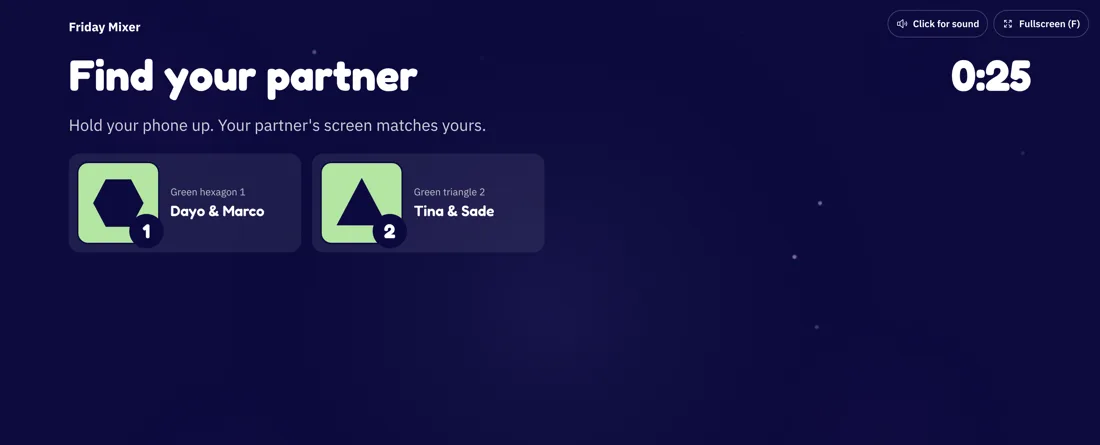
Guests scan a QR code, type their name and add a line to be spotted by, like "yellow jacket". No app and no account. When a chat starts, both partners' phones turn the same colour, with the same shape and number, so they hold their phones up and find each other across the room.
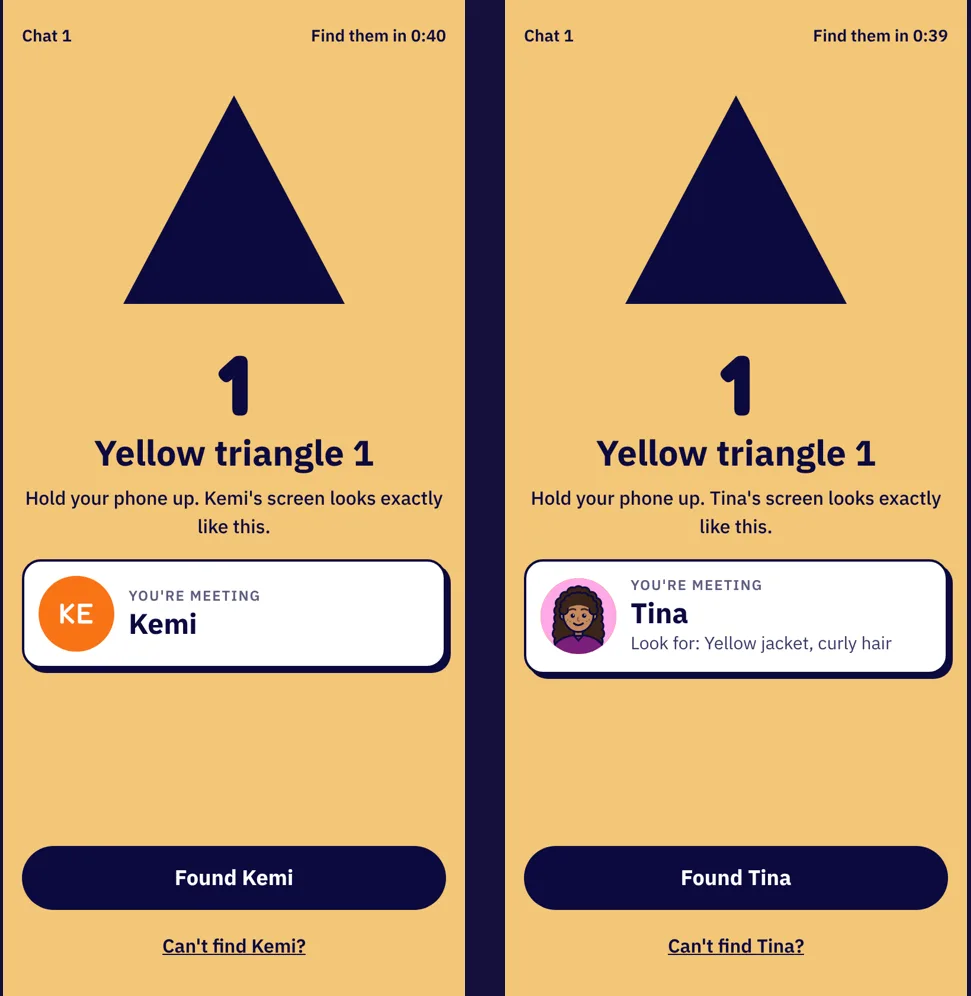
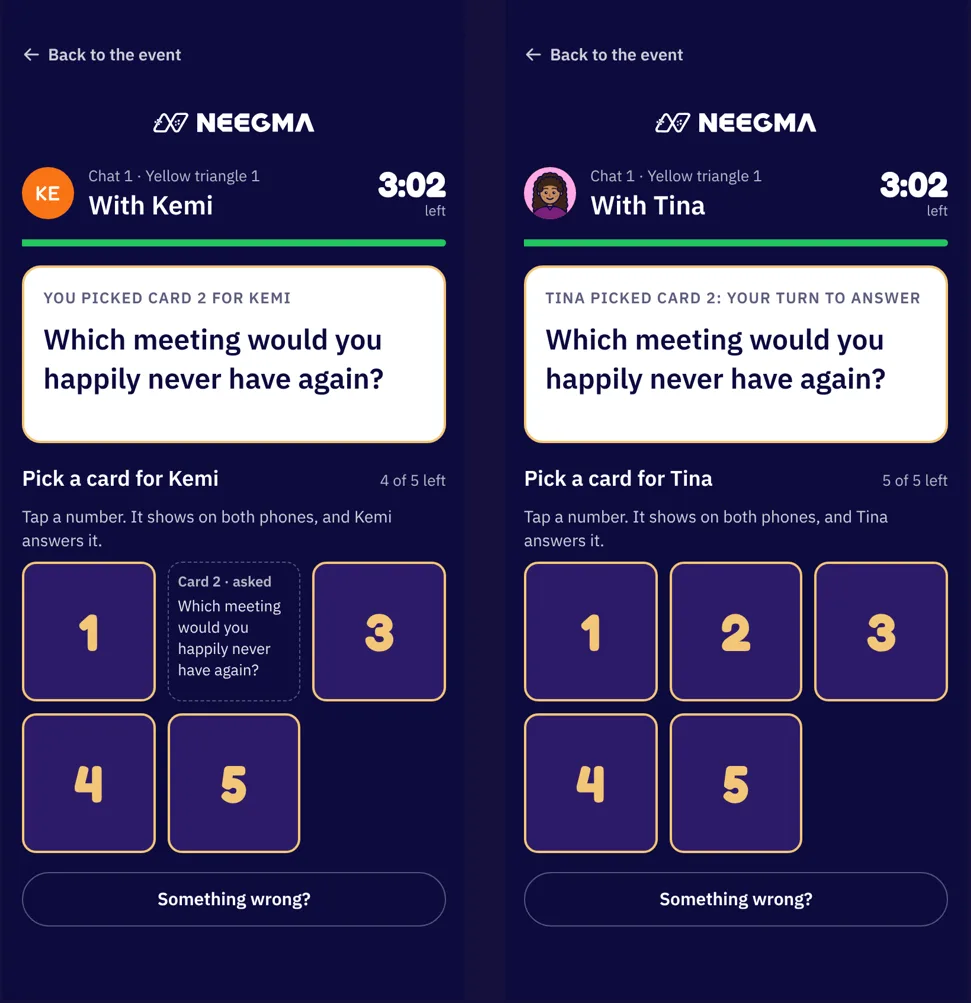
Then they take turns tapping a numbered card. The question shows on both phones and the other person answers it, so there is always something to talk about. Each chat runs for three minutes by default, anywhere from one to ten, and the pairing follows the rules above: whoever waited last goes first, then the most strangers, never the person you just met while someone new is free.
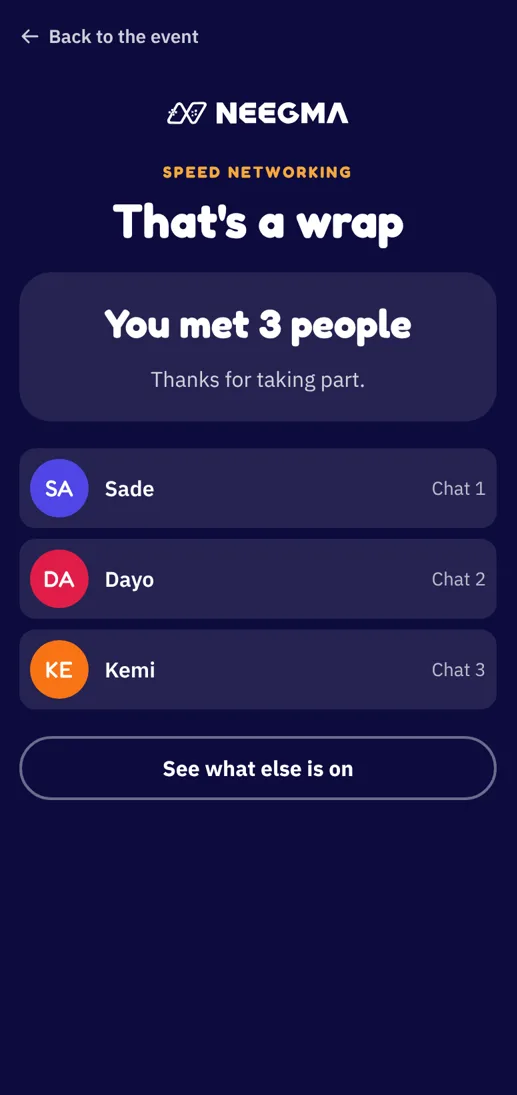
Can't find your partner? The phone offers someone else who is free. Odd numbers? Choose whether one person sits out or a group of three forms. The big screen shows every pair and the clock, your host screen lets you add a minute, pause or move on early, and when it ends everyone's phone lists the people they met, in order.
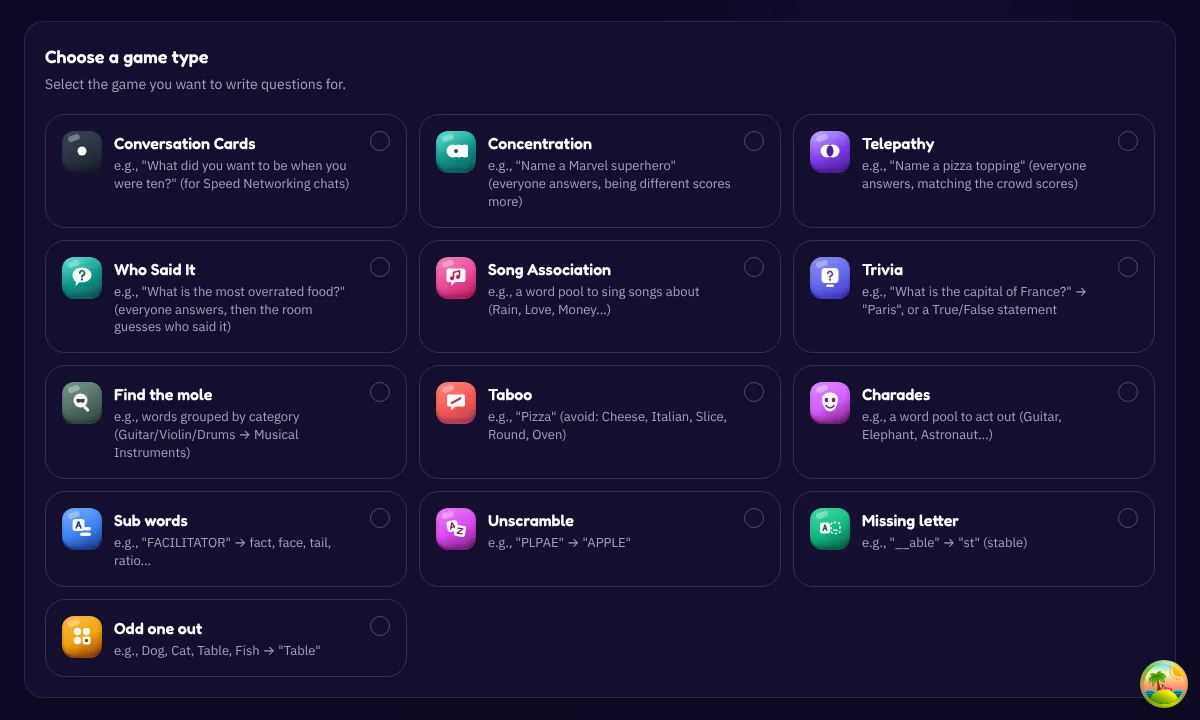
You can write your own question cards in the Neegma Playground, import them from a CSV or ask Create with AI for a set, and mark each card light or deeper so chats warm up gently. Or start from one of our sets, like Getting to know you and Work friends, and edit it for your crowd.
A Speed Networking room sits on your event's link next to your live game sessions, Live Q&A and raffles, so the same QR code can take people from a quiz to a round of introductions. It comes with every paid plan, on a Personal or Business account, from a 24-hour Party Pass to Pro and Enterprise. Read more in Party Passes explained.
Questions hosts often ask
How many people do I need?
Six is the practical minimum for enough variety; it gets better from about twelve. Neegma rooms take up to 200 people.
Do guests need to download anything?
No. They scan a QR code and join in their phone's browser, with no account.
What if someone leaves halfway through?
Their partner's phone offers someone else who is free, and the next round pairs everyone who is still there.
Can I use it for virtual events?
Speed Networking in Neegma is designed for people in the same room, finding each other by colour and shape. For a remote team, try a game everyone plays together, or our asynchronous team building games.
What do I do after the last chat?
Give people somewhere to continue: a game, food, or a shared table. Everyone already has a list of who they met, so the second conversation is easy to start.
A room where everyone has spoken to eight new people feels completely different from one where everyone has spoken to two. Add Speed Networking to your next event and see who your guests meet.